Showing posts with label Italian culture. Show all posts

Thursday, July 19, 2012

A Long-Standing Affair

Italians are wedded to their automobiles. In fact, Italians own more cars per person than citizens of any other country in the world32 million motor cars for 57 million people. That’s more than one car for every two people. Be it a Fiat or a Ferrari, it makes Italian hearts flutter.


Italy’s love affair for the automobile is reflected by the language. While the word automobile exists in Italian, the word macchina is more common. Macchina means machine, obviously, and is used in conjunction with descriptors to refer to other objects, such as macchina di fotografica for camera, but just say macchina, and Italians immediately think you’re talking about a car.

I’m sure this love for automobiles led Pope Pius XI to appoint a patron saint for automobile drivers in 1925. The Pope tapped Saint Francesca Romana for this position, so the legend goes, because an angel always carries a lantern ahead of her to light her way, keeping her safe from harm. Canonized in 1608, Saint Frances never had a glimpse of an automobile of course, but the image of a light darting in front of her must have been the closest thing the Vatican could find. People still drive by the Santa Francesca Romana church (near the Colosseum) on March 6 in hopes of being blessed. Watch the 1936 ceremony below.

 
This deep-seated cultural predilection for cars is being combined with the Italian love for coffee come October when Fiat introduces the new 500L which has an optional built-in Lavazza espresso machine between the two front seats. I’m not sure the combination will catch on. Going to the bar for a cup of espresso is as integral to Italian life as driving. Besides, the economic situation is making people cut back, and an option that can only be used when the car is in park could be easy to pass up. If you’re going to park anyway, why not just go to the bar?
The economy is ravishing the romance in other ways as well. Gasoline prices in Italy are the third highest in the world at $9.35 a gallon. Taxes account about 54 percent of this amount, a rise of more than 25 percent over the last year. These increases are part of Prime Minister Mario Monti's plan for economic recovery, and a two euro-cent increase in May aids earthquake victims. These higher prices have reduced both gasoline and automobile sales. Even so, the tax raised 33.5 billion euros during the first six months of this year. I do notice less traffic, however, and people are cutting back on holiday driving.
 
Will Italians divorce themselves from their macchine? Not a chance. Like any marriage, this one is facing a rough spot, but love will prevail in the end.

Monday, January 30, 2012

Condoms and Cappuccino: Italian Vending Machines

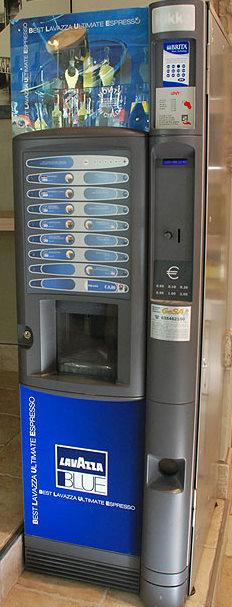
Cappuccino Machine
Vending machines are slowly making their way into the Italian culture. I saw my first one in Italy about fifteen years ago—a machine dispensing espresso and cappuccino in the Milan train station. I was horrified. Italian bars are so efficient that you can get a quick cup of coffee in the time it takes a paper cup to fall in a vending machine. And I had unpleasant memories of foul coffee coming from machines in America. I didn’t try that coffee at the time, but made my way into the bar next door.

When I came to live in Rome ten years ago, there were three common vending machines. The first, machines that take your photo and automatically prints it, are scattered across the city. It Italy you have to provide your own photos for identity cards and the like and you need these for everything from transit passes to drivers’ licenses to residency permits. In fact, I was able to get the correct size from one of those machines the last time I renewed my U.S. passport.

Condom Machine
The other two types of vending machines were located outside pharmacies and tobacco shops to provide emergency supplies 24-7: cigarettes and condoms. Since most shops close at 8 p.m. daily, these machines were both very popular. Pharmacies and tobacco shops still provide this service today, but vending machines are slowly making their way into other aspects of the culture.

Until about five years ago, for example, public transit tickets could only be purchased at tobacco shops, some news stands, and bars—never in the subway stations. Now there are “automatic ticket machines” in most stations, but the personnel still don’t sell tickets.

Vending machines have not made their way into the public schools—yet. Most schools and workplaces with lots of employees have bars where you can get a cup of coffee or a soft drink, a sandwich or a plate of pasta. With that kind of service available, vending machines are superfluous.

The Way I Prefer Cappuccino
Most of the time. For the past few years, I’ve done occasional work at the Italian Ministry of Culture. Imagine my horror when I first went there and looked for the bar. I was directed to a vending machine area housing snack and coffee machines. The latter identical to the one I had first seen in the Milan train station. My immediate reaction was to forgo coffee, but my Italian clients, being the hospitable souls most Italians are, began dropping money into the machine and asking me to choose my poison. I chose cappuccino and prepared my mouth for unpleasantness.

The machine whirred and gurgled a minute, then a cup fell down and frothy milky coffee poured into it. There was even a stirrer. The coffee was gooood. Almost as good as that served in a bar. I truly hope that these machines don’t catch on because losing the Italian bar as an institution would be a real loss, but in a pinch, I hope I’ll find one of these machines when a bar isn’t available.

Wednesday, December 14, 2011

The Many Shapes of Pasta

“Do you like fettuccine?” a friend asked as she was preparing to cook the pasta for a dinner party. Her question amused me because it highlighted the Italian obsession with pasta shapes. She didn’t ask me if I liked tomato sauce, or clam sauce, or any other accompaniment. She wanted, I mean really wanted, to know if fettuccine pleased me.   
The main pasta aisle in a nearby supermarket holds vast
quantities of dried pasta in a myriad of shapes and sizes.
There is more pasta on the opposite side, and fresh pasta
 resides in the dairy case.

This obsession with shapes and sizes of pasta permeates the culture. I once encountered a woman in a grocery store shortly before Christmas. She searched for a specific size of spaghetti. Spaghetti comes in many sizes, numbered roughly from one (what we Americans call “angel hair”) to thirteen, a very thick noodle indeed. I think she wanted size six and the store had only size seven. That just wouldn’t do. It didn’t go with the sauce she planned to serve.

I’ve always preferred the smaller types, angel hair and such, simply because they cook faster—in about three minutes, but I’m developing an appreciation for the thicker varieties after so many years here. Some of these can take fifteen minutes to cook.

Tradition governs which type of pasta should accompany which type of sauce. I’m not an expert on this topic, and I have to admit that my eyes glaze over when someone tries to explain. I think, but I’m not really sure, that you should use ridged pasta with creamy sauces and smooth pasta with chunky ragu or vegetable pasta.

Early in my days in Rome, I bought a series of books issued weekly with the newspaper featuring only pasta dishes. I didn’t get the index until the series ended. Imagine my surprise, and frustration, when I discovered the index was arranged by pasta shape only. You couldn’t look up “eggplant” or “rabbit” to find recipes by ingredient. The index listed fusilli, mezze maniche, bavette, pappardelle.

In my first years in Italy, more than forty years ago, I learned to make pasta by hand using a hand cranked machine. Taking the machine back to the U.S. led to my career in cookery because at that point, few people in America had ever seen a pasta machine. I taught cooking classes, wrote a newspaper column, and developed a fan base of people who liked to eat my pasta. When I began returning to Italy again in the 1980s, I boasted to someone about this “achievement.”

“Oh,” he said, “you don’t want to make pasta with metal rollers. You need wood to rough up the pasta and make it hold the sauce better.”

So much for pride.

One commercial pasta company here charges high prices for their dried pasta because it’s made with zinc rollers. Apparently the zinc roughens up the pasta surface in a way that steel doesn’t.

My friend Diana Collins, a poet and long-time resident of Italy has written a gleeful poem about pasta shapes and has consented to let me share it:

Fusilli
Fusilli Bucati Corti

Not spaghetti, penne, linguine,
macaroni o fettuccine,
not angel's hair, or little ears,
wagon wheels, or bow ties,

not pappardelle, macaroni, lasagna,
or tagliatelle, not shells to stuff,
ravioli, rigatoni, or tortellini,
but it's fusilli I like best

steaming in a dish.
Mattress springs from a plate-
sized bed, chewy curlicues
of durum wheat, twists

glistening with tomato, eggplant,
green peppers and squash.  Little
al dente sauce-loving coils that twirl
through mushrooms and cream

or plow through pesto with gusto.
Golden snippets of telephone cord
relaying long, spiraling conversations
between hunger and appetite.

This past weekend, I took a gastronomic tour with journalists covering the Italian culinary scene. Over two days, we spent about nine hours at table plus sampling wares at factories. Near the end of the last meal, I compared the various things we had eaten, including varieties of pasta. The man next to me said, “Ma pasta รจ pasta. What matters is the sauce that covers it.”

So much for my lesson on pasta shapes.