Showing posts with label Bars. Show all posts

Thursday, June 21, 2012

A Slice of Life in Rome

By Patricia Winton

The Rome Reads Book Club met in a little-known bar to select next year’s reading list. We chose this bar because it provides two amenities required by the group: reasonable proximity to public transportation and ample parking. This group is made up of people who drive wherever they go, including a couple of motor scooterists, and those who get about on buses, trams and trains.

Everyone was settled with glasses of fruit juice or beer when I arrived. I went to the bar and collected an acceptable, if not outstanding, glass of wine for a couple of euros and joined my friends.

At the next table, a group of Chinese men and women gathered over drinks and embroidery. They worked on a communal project using the same fabric and gold braid, frequently comparing their work. One woman rethreaded her needle from time to time, pulling it through the fabric and up over her head. They reminded me of a quilting bee I saw my aunt host when I was a child.

Some Italians grouped around another table, sharing glasses and gossip, a favorite Italian passtime. On stage a couple of musicians tuned their instruments, occasionally drowning out our conversation. Some Italian teens strung out a line of chairs before the stage, preparing to enjoy the show. We put our book choices to a vote. The Chinese continued to stitch.

A singer joined the musicians, and they performed a set. The teens slouched in their chairs, ears on the band, eyes on passing girls. The Italian adults laughed at a joke. We assessed our book choices and assigned dates for each discussion. The Chinese admired their handiwork.

The band took a break. We folded our notes and talked of vacation plans. One goes to Stromboli, an Italian volcanic island; another is off to a music festival in Strasbourg, France; a third plans to loll at Lake Vico north of Rome. I am off cruising some Greek Islands. The teens bunched together to trade insults and assess what they’d heard and seen. The Chinese continued to stitch.

The musicians returned and struck up a catchy rhythm, heavy on the bass. Outside, a dog joined in, barking to the beat. The band took another break; we gathered our belongings and ambled away, leaving behind the gossiping Italians, stitching Chinese, and barking dog.

On the street, we wished each other a good summer--those on wheels heading in one direction, those on foot another.

A good time was had by all.
December Choice


Monday, January 30, 2012

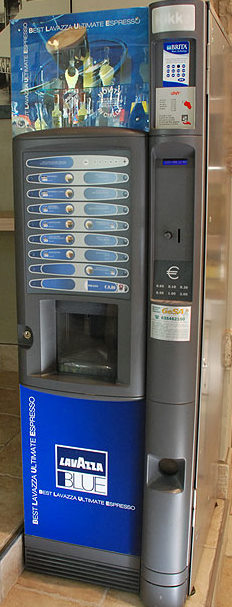
Condoms and Cappuccino: Italian Vending Machines

Cappuccino Machine
Vending machines are slowly making their way into the Italian culture. I saw my first one in Italy about fifteen years ago—a machine dispensing espresso and cappuccino in the Milan train station. I was horrified. Italian bars are so efficient that you can get a quick cup of coffee in the time it takes a paper cup to fall in a vending machine. And I had unpleasant memories of foul coffee coming from machines in America. I didn’t try that coffee at the time, but made my way into the bar next door.

When I came to live in Rome ten years ago, there were three common vending machines. The first, machines that take your photo and automatically prints it, are scattered across the city. It Italy you have to provide your own photos for identity cards and the like and you need these for everything from transit passes to drivers’ licenses to residency permits. In fact, I was able to get the correct size from one of those machines the last time I renewed my U.S. passport.

Condom Machine
The other two types of vending machines were located outside pharmacies and tobacco shops to provide emergency supplies 24-7: cigarettes and condoms. Since most shops close at 8 p.m. daily, these machines were both very popular. Pharmacies and tobacco shops still provide this service today, but vending machines are slowly making their way into other aspects of the culture.

Until about five years ago, for example, public transit tickets could only be purchased at tobacco shops, some news stands, and bars—never in the subway stations. Now there are “automatic ticket machines” in most stations, but the personnel still don’t sell tickets.

Vending machines have not made their way into the public schools—yet. Most schools and workplaces with lots of employees have bars where you can get a cup of coffee or a soft drink, a sandwich or a plate of pasta. With that kind of service available, vending machines are superfluous.

The Way I Prefer Cappuccino
Most of the time. For the past few years, I’ve done occasional work at the Italian Ministry of Culture. Imagine my horror when I first went there and looked for the bar. I was directed to a vending machine area housing snack and coffee machines. The latter identical to the one I had first seen in the Milan train station. My immediate reaction was to forgo coffee, but my Italian clients, being the hospitable souls most Italians are, began dropping money into the machine and asking me to choose my poison. I chose cappuccino and prepared my mouth for unpleasantness.

The machine whirred and gurgled a minute, then a cup fell down and frothy milky coffee poured into it. There was even a stirrer. The coffee was gooood. Almost as good as that served in a bar. I truly hope that these machines don’t catch on because losing the Italian bar as an institution would be a real loss, but in a pinch, I hope I’ll find one of these machines when a bar isn’t available.

Wednesday, September 21, 2011

Hanging Out in the Local Bar

The Morning Crew
            There’s nothing quite like an Italian bar. It’s a community center: a place to eat or drink, to meet friends, to read the paper, to sit and dream, even to write a blog post. Only a small portion of the profits come from alcohol!
            I have a new favorite, Caffe Paradisio, around the corner from where I live. They have free wi-fi, and I have been dropping by with my little computer a couple of times a day since I returned to Rome. In the morning I’m there to check email, Facebook and Twitter from the U.S. while I enjoy a cup of cappuccino. The cappuccino costs ninety euro cents. If I don’t order a pastry, they bring me a small plate with a few cookies. And it’s perfectly okay to order just a glass of water.
            It’s ten a.m., and I’ve been sitting here for about an hour. A constant stream of people flows through. A man with his dog sat at the table near me, reading the newspaper the bar keeps for customers.  Several couples have been here, taking a quick coffee and pastry standing at the bar before going to work. A woman who works at a nearby pizzeria came in to pick up espresso and cappuccino to take back to the restaurant. The barista prepared the drinks—in real cups—and sent her off with a tray, each cup covered with foil to keep the coffee hot. She’ll bring back the dirties later. My hairdresser, whose shop is next door, came in waving at me, and a woman’s studying English sat near me doing her homework.
         Espresso and cappuccino generally cost a dollar more or less, so it's usual for one in a party to treat the others. I just overheard a man asking his two companions what they wanted. Each said espresso, but he tried to offer additional things. Caffe machiato is espresso with a splash of steamed milk, for example. Or a highly sweetened whipped cream might be added to the cappuccino or the espresso. He also offered pastry, but they declined. People don't linger over their coffee either. The threesome I mentioned have already gone, and the waiter has collected their cups. They had an animated conversation, and the host paid about three dollars for the session. It's this rapid turnover that makes a bar profitable, so they can indulge someone like me who parks.
            Many bars offer complete lunch. This one doesn’t, but on a nearby corner there is another one where you can get a choice of pasta dishes, meat and fish, several vegetables, and dessert. All the food is wedged on platters behind a glass case. You make your selection, pay the cashier, and the food is brought to your table. I recommend bar lunches to travelers because they are fast, usually cooked from scratch, and always good.
            In the afternoon, I’ll be back here again. I may order a Campari soda or a nonalcoholic drink called “bitter.”  These drinks, whether alcoholic or not, cost the same—€2.50. With my drink, the staff will bring snacks at no extra charge.  These will include some form of chips, a small plate of tiny sandwiches, a little bowl of nuts, and perhaps a savory pastry or cheese.  If I’ve ordered iced tea instead, the snacks will be fewer, but will include some cookies. These little snacks accompanying drinks are commonplace in Italy. A few-not-so-friendly places may offer only a small bowl of chips, but the tradition calls for ample snacks.
            The bars offer other services as well. You can get lottery tickets, top up your cell phone credit, buy bus tickets or a candy bar. And it’s a quick place to buy a bottle of milk when you run out. Need directions to a local sightseeing point? Stop by a bar. Want to have a quick business meeting. Take your client for an espresso. Looking for a place to wait before cinema tickets go on sale? You’ll find other moviegoers at the local bar having a Coke.
            The staff takes pride in knowing the customers’ preferences. After only a couple of visits they remember that I prefer a slice of orange instead of lemon in my Campari and that I want brown sugar with my cappuccino. And because I linger, they always take away my used crockery or glasses and bring me a large glass of water—with ice and lemon.
            Caffe Paradisio has flat screens mounted high on the walls where music videos usually play, but at soccer time they are tuned in to the game, and it’s standing room only for Rome’s rabid fans. A small room to the back houses some slot machines. The sound of coins dropping when a player wins can drown out the music.
            Children are an integral part of Italy’s bar scene. A mother with a baby in a stroller comes in for her caffeine fix each morning. All the patrons speak to the baby, bending to greet her. In the afternoon, the barista and the cashier have their young daughter ensconced at a corner table, drawing pictures or playing with toys. Customers know her by name and stop to have a conversation. And frequently, the afternoon waiter has his toddler sleeping in the back room. On Saturdays, I see grandparents with grandchildren in tow for a weekend outing. At some point they’ll stop by a bar for ice cream, juice or the ubiquitous Coke.
            One of the real luxury services offered by bars is delivery. Businesses often call the local bar with a drink order (espresso, cappuccino, juice, etc.) In a short time, a delivery arrives, in real cups and glasses. The cashier will have prepared the bill; then the waiter will scurry off with the order and return with the money. Later he (or she) will amble back to pick up the empties. I fantasize about having a cup of cappuccino delivered to my home every morning while I’m still in my jammies, but then I’d miss the show.
           
The Afternoon Crew

Wednesday, July 13, 2011

The Titty Bar


There’s an establishment in my Roman neighborhood called the Titty Bar. It’s not what you think.

Prim grandmothers meet there for morning coffee after hitting the market, dragging their shopping carts along. Workers from nearby offices crowd in at lunchtime for a plate of pasta. Teenagers arrive in groups after school to sip Cokes and text absent friends.

The Titty Bar is named for a cartoon character. Can you guess which one? It helps if you know a bit about Italian pronunciation. Generally, with some precise exceptions, all vowels are pronounced the same way every time: a is “ah,” e is “a,” i is “ee” o is “o,” and u is “oo.” So that means titty is pronounced teety.

Still can’t guess? An additional hint: there are some letter combinations in English that are impossible for Italian speakers. The “th” sound wreaks the most havoc. This particular sound is difficult for Italians because the “h” doesn’t exist as a sound in their language. It exists as a letter solely to indicate the correct pronunciation of the vowel that follows it or to underscore meaning. For example, the word ci in Italian is pronounced like beginning of the English word “cheese” while the word chi is pronounced like the English word “key.” In both cases, the “h” tells us how to pronounce the vowel. When Italians see and “h” in English, they ignore it.

Birthday becomes beertday. Notice that the “i” becomes “ee” and the “h” disappears. Third becomes teard. I spend lots of my time as an English teacher sticking out my tongue at my students to get them to practice the “th” sound.

But that doesn’t help you identify the Titty Bar. Another combination causing grief to Italian students of English is the “tw” sound.  Italians ignore the “w,” so Titty is the Italian pronunciation of Tweety.  And Tweety is surprisingly popular here. His image, and name, appear on children’s pencil cases and on t-shirts and even on kitchen appliances. Yes, there’s a Titty cappuccino maker!

Sometimes Titty is spelled Titti. My last cat was named Nefertiti, and I called her Titi. I always do a double take when I see this alternative spelling. It’s not as provocative, but it evokes a warm reaction from me every time.