Wednesday, November 30, 2011

Writing in a Foreign Land

Note:    For the first time, Italian Intrigues features a guest blogger.  Please welcome Cassy Pickard, another Sister in Crime. My first post on Novel Adventurers appears December 1.
 
Cassy Pickard
As writers we invent. We create worlds that first exist only in our minds and then we figure out how to put that on a page so others are invited to join us. We want readers to see our characters as people who are advancing through their struggles. We also want them to see the streets our creations live on, smell the aromas from where they eat, hear the buzz of the motorcycles along the street and learn about the details of their lives.
My stories take place in Italy. It’s a country I have been visiting for forty years. We own a house there. I go many times a year. And, I have learned that I can’t “feel” the country on Google or on any website. Let me share with you an experience I had a few years ago.
My husband and I were traveling in Italy and he made the genius suggestion that I stay on to research a portion of the book I was writing. “Take a week,” he said. “I’m fine heading back. You have lots to do.” I hesitated, then grabbed the moment.
I spent five days doing just that. I walked Rome in ways I had not done before. Even with the many times I have been there, this was different. I was looking for the apartment house my heroine lived in. I took photographs not of classic sites but of where my gal lived and worked—memories for me to be sure to keep for my pages to be written.
In Rome, women don’t usually jog or run. I planned the path for my protagonist to flee in a moment of terror and then I ran it. So, I literally busted my buns to get from Point A to Point B, timing it. I had to make the scene for my book real. People stared. One man yelled to me, asking if I needed help. I ended up joining a huge protest group who were rallying about civil rights. I realized it was a good place to hide from the bad guy chasing me. I almost began to believe he was real. My heart was pounding. The protesters were chanting. I had to pull out my map to reorient. I was actually slightly nervous to leave the safety of the large anonymous crowd for my imaginary pursuer could miraculously appear.
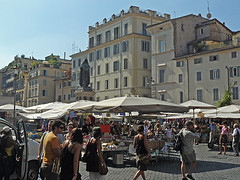
Piazza Campo dei Fiori
Then as I moved on to Piazza Campo dei Fiori, I had forgotten that the large farmer’s market filled the square. It was rich with details that I could never have found on Google or any other site. Chickens hung in the makeshift stalls, huge bins of herbs and spices lined the front of a number of vendors, a full kitchen shop was set up on multiple tables, and of course the flowers. I could have bought one of everything. I’m a total lover of outdoor markets.
I decided to have lunch at the edge of the piazza and watch the parade of people. With a glass of wine in hand, it became clear that I had to be there. I had to feel it, smell it, watch it, and then hopefully know it. And my dear character was right by my side. She loved it too. That was until I had to make her life much more difficult with what I plotted for the next scene.

Cassy Pickard has invented herself a number of times. She is a registered nurse, holds two master's degrees and a PhD in research methodology. She has been a health care consultant, an entrepreneur, and an associate dean at Yale University. Now she lives vicariously through her characters. She splits her time between Connecticut and Italy. Visit her at http://www.cassypickard.com/ and http://www.mysteriesandmargaritasblogspot.com/ or email her at cassy@cassypickard.com 

Wednesday, November 23, 2011

An Italian Thanksgiving

Note: Today, I’m a guest on Writers Who Kill. These crime writers are creating a Thanksgiving Potluck with recipes from a slew of sleuth creators. Check it out at http://writerswhokill.blogspot.com/ 


       Last year, I cooked a traditional American Thanksgiving for friends, complete with stuffed turkey and cranberries, and of course pumpkin pie. I’m doing Thanksgiving on a very small scale this year, using local ingredients and giving the feast a decidedly Italian flair.

I’ll serve a pumpkin pasta dish. When I wrote about pumpkins a couple of weeks ago, Ren left a recipe in the comments. I made it, and it was far too much for me, so I created something new with the leftovers. It was good enough to make again. I cooked together equal parts of onion and pumpkin. You could use canned pumpkin, but you’d need to cook the onions for a long time before adding the pumpkin so they’d be soft. In another frying pan, I cooked lean sausage in a bit of olive oil with a pinch of red pepper. When the sausage was done, I combined it with the pumpkin-onion mixture. I added a grating of nutmeg and fresh parmesan. This is already waiting in the fridge. Tomorrow, I’ll cook the pasta.

Involtini di Tachino
My main course is  Involtini di Tachino (Turkey Rollups). To make these, I will take turkey breast slices, top each with prosciutto, chopped spinach with a grating of nutmeg, and mozzarella. I’ll rolled them up and fasten with toothpicks or kitchen twine. Then I’ll brown them on all sides in a bit of olive oil. When they’re all good and brown, I’ll add a bit of white wine and braise for about twenty-five minutes. When done (and I’ll check with an instant meat thermometer to make sure they are done.), I’ll set them aside to rest while I finish everything else. Before serving, I’ll slice the rollups to make pinwheels.

My main veggie is Brussels sprouts with chestnuts. I’ve already washed and trimmed the sprouts, and Thursday morning I’ll pick up chestnuts from a chestnut roaster plying his wares on the street. That’s the lazy woman’s way out on a busy day, and since it isn’t a holiday here, everything else is business as usual. I’ll steam the sprouts a little ahead and plunge them in ice water to maintain the color. At serving time, I’ll melt a little butter and toss the sprouts and peeled chestnuts together.

I’ve made a compote of dried cranberries and oranges that’s tangy and sweet--just the right foil for the turkey. 

When I’m out buying the chestnuts, I’ll drop by the bakery for some crusty bread. I’ll pour a nice white wine from the Castelli and finish off with a cup of espresso and apple pie.

    I have a lot to be thankful for.

Wednesday, November 16, 2011

The Heat Is On!

     The outdoor temperature in Rome has dropped to below fifty degrees F., and the heat came on around the city yesterday. Most apartment buildings have central heating that is regulated by condominium votes. By law, the heat must be turned on by November 15, and most buildings wait until the last minute. Even in very tony neighborhoods, this is the norm.
In some places I have lived, the heat comes on for a few hours in the morning and then goes off until early evening when it reappears for a few more hours. In the place where I’ve lived for the past eight years, the heat is always off in the morning. Yesterday, it came on at about six p.m., and probably went off around eleven. By that time, I had tucked myself into bed with my hot water bottle, so I’m not sure of the exact time.
When the weather gets colder in January and February, the heat will probably run from about one p.m. At least, that’s been the practice in the past. Fortunately, the weather has been extremely mild this year.
In recent years, some people have installed heating/air conditioning systems with individual controls, but most of the people I know with these systems still use them sparingly.
Because I never have heat in the morning and because I like morning showers, I bought a little heater that I use to warm up the bathroom in the morning. After my shower, I roll it under my desk to take advantage of its lingering warmth.
I’m lucky that my apartment is well-insulated. My window wall faces south, so unless a chilling wind blows from that direction, I’m usually warm enough with sweaters and extra socks. I just bought a fabulous pair of bedroom boots (they’re not slippers). They have removable cushions that pop into the microwave for a couple of minutes and keep my feet toasty warm.
When I first came to Italy many years ago, I wasn’t accustomed to the rationed heat. Even though my first apartment had an individual control for the heat, I caused a major problem by turning my heat up high. The furnace couldn’t handle the stress and belched soot all over the apartment adjacent to the furnace room. I rented a portable gas heater, and I cringe now to realize how dangerous that probably was.
Now, I’m used to indoor temperatures that reflect the outdoor ones without too much contrast. Thus, when I go outside on a cold day, I’m not shocked by the cold. And in summer, I don’t wilt immediately upon exiting a building. I now find the extremes of central heating and air conditioning in the U.S. very uncomfortable.

Wednesday, November 9, 2011

Creating a Murder Scene

       Rome has a thousand churches. When I began writing my novel that features murders in church, I couldn’t envisage building a new one, even in my imagination. I wanted a church that served as a real parish, not a pilgrimage point.
      
       At first, I looked outside the city center, examining churches in my own neighborhood. They are not historic; in fact, many churches near me date only from the twentieth century. I wanted something older, more in keeping with Rome’s past, so I looked elsewhere.  

Some of the key scenes of the novel take place in a restaurant that I put in a small piazza near the Pantheon. As the plot developed, it became clear that the church needed to be nearby, so, map in hand, I set off to explore the neighborhood. The Pantheon itself is a church, but it wouldn’t do. Too many tourists. Saint Louis of the French stands around the corner, but it also sees hordes of visitors every day.
Discouraged, I traipsed to a couple of other churches before stumbling towards Saint Mary Magdalene. An iron gate separates this church from a small piazza. Traffic speeds along the side, and across the street coffee drinkers chat at outdoor tables.
Four curved travertine steps lead up to the entrance. Inside, late Baroque and Rococo extravagance explodes. The altar holds six very tall bronze candlesticks supporting simple cream-colored candles and the busts of four popes. Rosettes, braids, and garlands adorn every surface. It looks as if a paintbrush dripping with gold has washed the entire sanctuary, from pope busts to capitals above the marble columns.
The piece d resistance rests on a gilded platform above the entrance: a pipe organ wrapped with putti and garlands, white stucco statues of allegorical figures and winged angels, all resplendent with garlands and scrolls. The paintbrush cut a swath here, too.
I knew I’d found my church when I walked forward. Near the altar, a priest—in collar and shirtsleeves—stood over an ironing board pressing altar cloths. A homey, neighborhood atmosphere.
I’ve since visited the church at different times of day. Once at evening mass, just three worshipers took part in the service. During Sunday mass, the church fills.
It fits my purpose. Even so, it seemed improper to commit murder in a holy space. To ease my conscience (and, as I've later learned to please publishers), I created an imaginary chapel for staging the murder.
I wanted to call it the Madonna Chapel, but Saint Mary Magdalene already has a chapel called Madonna of the Sick. That wouldn't do because it's holy space, and too public besides. I created another one reached through an actual door in the very real Crucifix Chapel. That door leads into the Via delle Colonelle where our murderer would have found very little privacy.
While I hesitate to invite tourists to visit here and interrupt my murderer, the Church of Saint Mary Magdalene, known in Rome as La Maddalena, is worth a visit if only to see baroque design at its most outrageous.

Wednesday, November 2, 2011

Beyond Jack O’Lanterns and Pumpkin Pie


           Italians rarely use pumpkin for desserts, but it is frequently eaten as a vegetable in winter months. Canned pumpkin can be found in expensive import shops for about $5-8 per can, but pumpkin is readily available by the slice. Supermarkets have sliced pumpkin wrapped in plastic in the produce section. In vegetable markets, you can usually get the stall keepers to slice off a chunk of pumpkin with you choosing the width of the slice.
I find pumpkin somewhat difficult to peel, so I usually pop it into the microwave for a couple of minutes before carving out the pieces. If I want pumpkin puree for something like gnocchi or noodles, I nuke it for about fifteen minutes, making sure to have it in a bowl to catch the liquid it exudes. Then I scoop out the pulp and set it in a strainer for about half an hour for the additional water to drain, then puree it in a blender or food processor.
If you want to use your Halloween pumpkin, or part of it, you can also cook it in the oven for thirty to 40 minutes, again making sure it in a pan with deep sides to collect the excess water. Otherwise, you’ll flood your oven. This fresh pumpkin puree tastes stronger and fresher than the canned variety. Substitute two cups of fresh puree for a one-pound can of pumpkin.
Cubed pumpkin sauted in olive oil with garlic and rosemary makes a welcome autumn side dish. Sometimes it’s cooked with olives or onions, often paired with rosemary.
Soups based on pumpkin come in many forms. Sometimes with chick peas or with spinach. Other times it’s cooked with onions and small pasta shapes. You can also find many different types of risotto using pumpkin. I love gnocchi, little dumplings, made with pumpkin instead of potato and topped with a gorgonzola sauce.
But pumpkin reigns in pasta dishes. It’s often a filling for ravioli or tortellini and other stuffed pastas. It can be used to make pasta dough and cut into tagliatelle or fettuccini. Pasta flavored this way can take a delicate butter and parmesan sauce or a stronger sauce made with sausage.
Here’s one of my favorite recipes:
Lasagne con Crema di Zucca ai Formaggi
Lasagna with Pumpkin Cream and Cheese
8 ounces of fresh lasagna sheets (green, if available)
2 cups fresh pumpkin puree or 1 one-pound can pumpkin
3/4 cup grated parmesan
About 1 tablespoon butter (to grease the pan)
1/2 pound Fontina or other semi-soft cheese, cut into slices
1/2 cup cream
Whole nutmeg
Salt and pepper
1.     Preheat oven to 350 F.
2.     Cook the lasagna noodles in a large pot of lightly salted water until just barely al dente. Drain and stretch out on a clean kitchen towel to drain excess water.
3.     Mix the pumpkin pulp with 1/2 cup of the parmesan, cream, salt and pepper, and a grating of nutmeg.
4.     Butter a baking dish, and lay down one strip of lasagna. Spread on some of the pumpkin mixture, a layer of Fontina slices, and sprinkle on some of the remaining parmesan.
5.     Continue assembling these layers until all the ingredients have been used.
6.     Place the lasagna in the oven and bake for twenty minutes.
7.     Remove it from the oven and allow it to rest for a few minutes before serving.
8.     Serve with extra parmesan, if desired.


Wednesday, October 26, 2011

I'm Building an Ark

    The rain began falling in torrents around dawn, accompanied by flashes of lightning and cracks of thunder. It was the kind of intense storm that usually passes quickly, but this one stalled over Rome for several hours last Thursday. The city crashed to a halt.
The rain would appear to slack off, and people collected their coats and umbrellas and rubber boots to go about their business, then the rain and thunder and lightning would begin again. It was difficult to make out structures across the street because the heavy rain obscured visibility.
I didn’t have any appointments until two p.m., so I made minestrone and hot spiced apple juice as comfort food and snuggled up to my computer. The configuration of my apartment makes it impossible to see the street without going onto the terrace, so I was blissfully ignorant of the extent of the chaos.
At one o’clock, the sun came out, I polished my sunglasses, grabbed my bag and umbrella, and set out. I found the gates to the metro chained closed. Someone told me it was allagata, a word that means approximately 'made into a lake.' Since my local stop is shallow, I walked to the next stop, expecting to find it open. It wasn’t. I walked to the next. Closed. Then I began waiting for a bus. There were none.
In the hour that I was out, I was shined on by the sun, pelted by the rain, startled by the thunder and lightning. I finally gave up and canceled my appointments, but I didn’t learn the extent of the storm until I returned home to look at the news.
Rain flowed down steps into the underground like waterfalls, forcing one line--the one I use--to close half the route. The other line closed several stations due to flooding. In addition to that, water collected in the streets, forcing busses out of service.
While I was out, I had seen public works crews out trying to remove debris from the storm drains, but so much water had fallen in such a short period that it had the upper hand.
Water rushed into many businesses in my neighborhood and others throughout Rome. A small shop where I bought computer paper on Friday had lost lots of stock, including boxes of detergent, paper products and much more.
In central Rome, the rain tossed the city’s characteristic sampietrini paving stones as if they were coins, leaving great holes in the streets, described by one newspaper as 'chasms.' One man, living in a basement apartment, drowned in his bed.
The usual screams about how public officials handled the emergency are rampant. The mayor claims that it was a natural disaster and couldn’t be anticipated. The opposition points to other recent rainstorms, albeit not so severe, that produced chaos as well.
As the rain raged, information trickled. One of my friends boarded a bus that would have taken him within walking distance of home. On board, an announcement that the metro had reopened sent him off the bus at the main train station to take a subway home. Once off the bus, he discovered that the metro had not, in fact, reopened, and he found himself stranded at the train station.
Heavy rain is predicted in Rome today. Intense storms blasted the north yesterday with lots of damage. Four people died and six are missing. Mudslides covered highways and boats entered piazzas. 
The first thunderbolt just rumbled in Rome. It’s time to build an ark.

Wednesday, October 12, 2011

Lining Up


            Few things are as challenging about living in Italy as waiting in line. It’s a special trial at the supermarket where there is no “ten items or less” line such as American supermarkets have. I cringe when I arrive at check-out with my three items just behind someone with a cart chock-full. Sometimes, the person will see that I’m carrying few items and allow me to pass. At others, the person will avoid all eye-contact to dodge noticing my piddling purchases.
            Unlike the British, who stand in orderly queues, Italian people tend to bunch up instead. In that way, people cut into the line without being obvious. There’s a funny little woman that I see in various parts of Rome. She has a bright spot of 1950s-era rouge on each cheek and wears a plaid golf cap. She always plants herself by the display rack flanking the checkout line and eases her way ahead of the others.
            Another tactic some shoppers use is to leave a partially filled shopping basket in line with the pretext of going back for a forgotten item. Then the shopper returns with an armload of stuff and drops it into the basket, perhaps going back a second time. If you step ahead of the basket, the returning shopper will often complain vociferously that you’ve usurped her place.
            The lines move slowly, too. In an early blog (March 23, 2011), I wrote about how cashiers stop a line by asking customers dig for small change. But that’s only one delay. Conversation has a similar effect. 
In general, Italian people are chatty, and cashier and customer often engage in spirited small talk during the course of a transaction. Italian people use lots of hand gestures when they speak, and the cashier will stop ringing up the purchases to use his hands to make a point. And if the story hasn’t finished after money has been exchanged and groceries bagged, it continues, leaving the other customers waiting.
My Anglo-Saxon need for order makes me wait my turn. So I stand behind those people with filled baskets. It really gets my goat when my turn finally comes to have someone come up and say, “I have only three items, can I go ahead of you.” Since I’ll likely have only one, or two, or three myself, I always decline. And I’m perceived as rude.
Where practical, business establishments now use the “take a number” system. At the post office, at banks, at my doctor’s office (where she has office hours on a first come, first served basis) there’s a number machine. If someone tires of waiting, or changes her mind, she often puts the paper number on top of the machine for someone else to use. It’s always a thrill to find a usable number that lets you cut ahead of others without a twinge of guilt.
At my favorite busy market, several stalls have the number system, but even there people find ways to break line with various excuses. At the salumeria (cold cuts and cheese stall), I’ve often seen people say, “But I didn’t know you had to take a number,” and insist on being served ahead of us waiting our turn.
At the fish stall, I heard the best excuse ever. It’s a very popular stand, and there are frequently twenty or more numbers ahead of you. One day, a woman pushed forward saying, “I can’t wait for a number; my daughter’s having a baby.” It was unclear to me if the daughter was on her way to the hospital and the woman needed to finish her shopping quickly. Or if the pregnant woman craved fish. Or if she wanted to eat a plate of fish before delivery. Or if the mother had just learned the news and couldn’t cope with shopping in her excitement. Whatever the reason, she made her purchase ahead of the rest of us.
            I do get frustrated and annoyed when these things happen. But I have to shake my head and smile, too. It’s these cultural foibles that weave the fabric of my life in Italy. There are annoyances everywhere. I try to enjoy these.