Showing posts with label Writing. Show all posts

Wednesday, November 30, 2011

Writing in a Foreign Land

Note:    For the first time, Italian Intrigues features a guest blogger.  Please welcome Cassy Pickard, another Sister in Crime. My first post on Novel Adventurers appears December 1.
 
Cassy Pickard
As writers we invent. We create worlds that first exist only in our minds and then we figure out how to put that on a page so others are invited to join us. We want readers to see our characters as people who are advancing through their struggles. We also want them to see the streets our creations live on, smell the aromas from where they eat, hear the buzz of the motorcycles along the street and learn about the details of their lives.
My stories take place in Italy. It’s a country I have been visiting for forty years. We own a house there. I go many times a year. And, I have learned that I can’t “feel” the country on Google or on any website. Let me share with you an experience I had a few years ago.
My husband and I were traveling in Italy and he made the genius suggestion that I stay on to research a portion of the book I was writing. “Take a week,” he said. “I’m fine heading back. You have lots to do.” I hesitated, then grabbed the moment.
I spent five days doing just that. I walked Rome in ways I had not done before. Even with the many times I have been there, this was different. I was looking for the apartment house my heroine lived in. I took photographs not of classic sites but of where my gal lived and worked—memories for me to be sure to keep for my pages to be written.
In Rome, women don’t usually jog or run. I planned the path for my protagonist to flee in a moment of terror and then I ran it. So, I literally busted my buns to get from Point A to Point B, timing it. I had to make the scene for my book real. People stared. One man yelled to me, asking if I needed help. I ended up joining a huge protest group who were rallying about civil rights. I realized it was a good place to hide from the bad guy chasing me. I almost began to believe he was real. My heart was pounding. The protesters were chanting. I had to pull out my map to reorient. I was actually slightly nervous to leave the safety of the large anonymous crowd for my imaginary pursuer could miraculously appear.
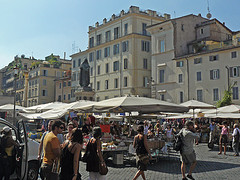
Piazza Campo dei Fiori
Then as I moved on to Piazza Campo dei Fiori, I had forgotten that the large farmer’s market filled the square. It was rich with details that I could never have found on Google or any other site. Chickens hung in the makeshift stalls, huge bins of herbs and spices lined the front of a number of vendors, a full kitchen shop was set up on multiple tables, and of course the flowers. I could have bought one of everything. I’m a total lover of outdoor markets.
I decided to have lunch at the edge of the piazza and watch the parade of people. With a glass of wine in hand, it became clear that I had to be there. I had to feel it, smell it, watch it, and then hopefully know it. And my dear character was right by my side. She loved it too. That was until I had to make her life much more difficult with what I plotted for the next scene.

Cassy Pickard has invented herself a number of times. She is a registered nurse, holds two master's degrees and a PhD in research methodology. She has been a health care consultant, an entrepreneur, and an associate dean at Yale University. Now she lives vicariously through her characters. She splits her time between Connecticut and Italy. Visit her at http://www.cassypickard.com/ and http://www.mysteriesandmargaritasblogspot.com/ or email her at cassy@cassypickard.com 

Wednesday, November 9, 2011

Creating a Murder Scene

       Rome has a thousand churches. When I began writing my novel that features murders in church, I couldn’t envisage building a new one, even in my imagination. I wanted a church that served as a real parish, not a pilgrimage point.
      
       At first, I looked outside the city center, examining churches in my own neighborhood. They are not historic; in fact, many churches near me date only from the twentieth century. I wanted something older, more in keeping with Rome’s past, so I looked elsewhere.  

Some of the key scenes of the novel take place in a restaurant that I put in a small piazza near the Pantheon. As the plot developed, it became clear that the church needed to be nearby, so, map in hand, I set off to explore the neighborhood. The Pantheon itself is a church, but it wouldn’t do. Too many tourists. Saint Louis of the French stands around the corner, but it also sees hordes of visitors every day.
Discouraged, I traipsed to a couple of other churches before stumbling towards Saint Mary Magdalene. An iron gate separates this church from a small piazza. Traffic speeds along the side, and across the street coffee drinkers chat at outdoor tables.
Four curved travertine steps lead up to the entrance. Inside, late Baroque and Rococo extravagance explodes. The altar holds six very tall bronze candlesticks supporting simple cream-colored candles and the busts of four popes. Rosettes, braids, and garlands adorn every surface. It looks as if a paintbrush dripping with gold has washed the entire sanctuary, from pope busts to capitals above the marble columns.
The piece d resistance rests on a gilded platform above the entrance: a pipe organ wrapped with putti and garlands, white stucco statues of allegorical figures and winged angels, all resplendent with garlands and scrolls. The paintbrush cut a swath here, too.
I knew I’d found my church when I walked forward. Near the altar, a priest—in collar and shirtsleeves—stood over an ironing board pressing altar cloths. A homey, neighborhood atmosphere.
I’ve since visited the church at different times of day. Once at evening mass, just three worshipers took part in the service. During Sunday mass, the church fills.
It fits my purpose. Even so, it seemed improper to commit murder in a holy space. To ease my conscience (and, as I've later learned to please publishers), I created an imaginary chapel for staging the murder.
I wanted to call it the Madonna Chapel, but Saint Mary Magdalene already has a chapel called Madonna of the Sick. That wouldn't do because it's holy space, and too public besides. I created another one reached through an actual door in the very real Crucifix Chapel. That door leads into the Via delle Colonelle where our murderer would have found very little privacy.
While I hesitate to invite tourists to visit here and interrupt my murderer, the Church of Saint Mary Magdalene, known in Rome as La Maddalena, is worth a visit if only to see baroque design at its most outrageous.